| |
|

print
Johannes Vermeer - Girl with a pearl earring
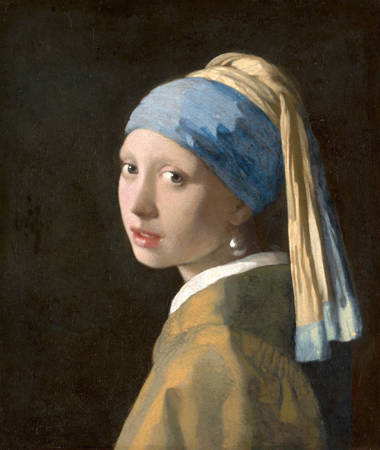
| Why is the Girl with the pearl earring Vermeer’s best-loved painting? It must have something to do with the fact that the girl looks over her shoulder, as though hoping to see who is standing behind her. This draws the viewer into the picture, suggesting that he is the one who has made the girl turn her head.
Equally important, though, are Vermeer’s fresh colours, virtuoso technique and subtle rendering of light effects. The turban is enlivened, for example, with the small highlights that are Vermeer’s trademark. The pearl, too, is very special, consisting of little more than two brushstrokes: a bright accent at its upper left and the soft reflection of the white collar on its underside.
Then there is the girl herself, who gazes at us, wide-eyed, her sensual mouth parted. She makes an uninhibited, somewhat expectant impression that cannot help exciting our interest, even though we have no idea who she is.
|
|
 |
| |
artist
Johannes
Vermeer |
title
Girl with a pearl earring |
period
c.1665 |
material
doek |
dimensions
44.5 x 39 cm |
|
|
| |
|
| A tronie ‘in the Turkish manner’
In the 17th century Dutch girls did not generally wear turbans. This painting, then, is not a portrait but what in those days was called a tronie. Though presumably based on a model, a tronie was actually a study of a head intended to represent a particular emotional state or figure type. This girl, for example, represents an exotic, Oriental type.
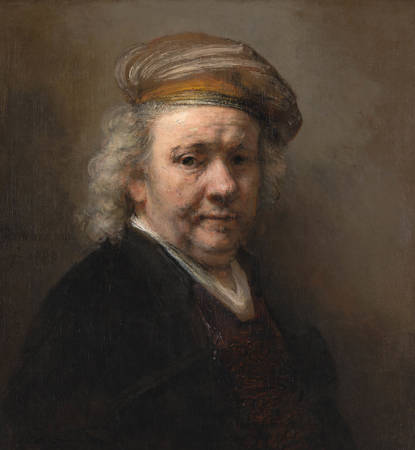
Around 1630 Rembrandt popularised the tronie in Dutch art. Vermeer painted at least two. The inventory of Vermeer’s possessions, drawn up three months after his death, lists ‘Two tronies painted in the Turkish manner’. The Girl with the pearl earring could well be one of these paintings. |
|
|
|
A bargain
In 1881 the Girl with the pearl earring was put up for sale in The Hague. The signature was no longer legible, however, and no one knew who had painted it. Even so, the painting attracted the attention of Victor de Stuers, an influential cultural adviser, who saw it on the viewing day with his friend and neighbour, the art collector A.A. des Tombe. They thought the painting interesting and agreed not to bid against one another at the auction.
Thus Des Tombe acquired the Girl for 2 guilders plus the 30- cent mark-up. The subsequent restoration laid bare the signature, and it was only then that Des Tombe knew that he had bought a genuine Vermeer for very little money.
When Des Tombe died in 1902, it appeared he had made a secret will in which he bequeathed to the Mauritshuis twelve paintings, one of which was the Girl with the pearl earring. |
|
|
|
Something added, something removed
The Girl with the pearl earring was restored in 1994. The yellowed varnish was removed, as were the retouches added during previous restorations. This brought to light the vivid colours originally used by Vermeer.
Here and there details appeared that had long been invisible. The most striking was a highlight at the left corner of the girl’s mouth: a minuscule dot of white paint on a dab of light pink.
The pearl proved to have one reflection too many. Examination revealed this white dot to be a paint flake that had come loose during a previous restoration and had landed, upside-down, on this spot. Its removal exposed the original paint layer underneath, which appeared to be in excellent condition. |
|
|
|
|
|
|
|
|
|
|
|
|
|